|
Worldwide Guide to Women in Leadership
WOMEN LEADERS
IN THE UNITED KINGDOM
Throughout the times
Includes
the former Kingdoms of England and Scotland
and various territorial Duchies and Counties
|

|
BCE
200's Queen Martia Proba of a Celtic Tribe |
|
Her
seat of power was in London, and she was holding the reins of
government so wisely as to receive the surname of Proba, the Just. She
especially devoted herself to the enactment of just laws for her
subjects, the first principles of the common law tracing back to her;
the celebrated laws of Alfred, and of Edward the Confessor, being in
great degree restorations and compilations from the laws of Martia,
which were known as the "Martian Statutes". |
|
|
Circa 40-60 Queen Regnant Cartimandra of The Brigants (Brigantia) |
|
Brigantia was a British tribe in Yorkshire. She signed a treaty with
the Romans, placing herself under their protection. Her tribe was
opposed to this treaty and there were several revolts. In 48, she
asked for and received Roman help in fighting the rebellion.
Cartimandua's consort, Venutius attempted to have her overthrown but
he was unsuccessful after the Romans came to her aid. For a while
Cartimandua ruled jointly with Venutius, but when he made another
attempt to overthrow her, she took Vellocatus, a royal armour-bearer,
as her consort. She sent Vellocatus to fight Venutius and, again,
asked for Roman help. Ca.69, Cartimandua "retired" and in 71, Rome
annexed Brigantia after they easily defeated Venutius, Vellocatus and
the Brigantes in battle. |
 |
60-61 Queen Regnant Boudicca of the Iceni-Tribe in Norfolk |
|
The
Iceni was a people who lived in the present-day counties of Norfolk
and Suffolk. She led a rebellion against the Roman authorities as a
result of their mistreatment of her family and people after the death
of her husband, Prasutagus, who may have been a Roman client-ruler, in
60 AD. She and other disaffected tribes, sacked the cities of
Colchester, St. Albans and London and, it is estimated, massacred
approximately 70.000 Roman soldiers and civilians in the course of the
glorious, but ill-fated rebellion. The rebels were finally defeated in
battle by a force led by the Roman governor of Britain, Suetonius
Paulinus, after which she took her own life by ingesting poison
together with her two daughters, Camorra and Tasca or, according to
legend, Voada and Voadicia. She lived (15-61). |
|
|
Around 60 Military Leader Queen Aife of Alba in Scotland |
|
In
Celtic mythology she was a female warrior from Alba. She gave her
lover, Cuchulainn, his spear, Gae Bulg. They had one son, Connla. |
|
|
Circa
772-98 Joint Reigning Queen Cynethryth of Mercia |
|
She
was the wife of Offa II, the Saxon King of Mercia (757-96), and
acquired notoriety as a tyrannical Queen. She was the only Queen
consort ever allowed to issue coins in her own name, and they carry
vivid portraits, the earliest portrait of an Englishwoman. Her
daughter, Eadburgh, acquired a still worse reputation. |
|
|
Before 825 Heiress Esyllt ferch Cynan of
the Kingdom of Gwynedd (Wales in the United Kingdom) |
Also known as Ethil, she was the heiress of her father, King Cynan
Dindaethwy of Gwynedd. She was married to king Guriat of Ynys Manaw (Isle
of Man). After the death of her uncle in 825, the throne was secured
for Merfyn. He crossed from Isle of Man, where he was almost certainly
already King, to bring a new stability as well as a new dynasty to
Gwynedd after many years of Civil War. He reigned for 19 years but an
absentee monarch left Manaw open to invasion. The Hiberno-Viking,
Godred mac Fergus established himself there in 836 and the country was
never recovered. |
|
|
Before 825 Regent Dowager Queen Angharad Ferch Maredudd
Llewelyn of Powys, Holderness, Skipton and Cockermouth (Wales and
England in the United Kingdom) |
|
Reigned in the name of her son. |
 |
911-918 Sovereign Lady Æthelflæd of Mercians |
|
Also known as Ethelfleda, Eþeleda, Aethelfled, Æthelfleda or Æthelflæd)
she became ruler after her husband, Aethelred or Ethelred, Earl of
Mercia, died after the Battle of Tettenhall, she became ruler of the
territory. She was a formidable military leader and tactician. She
ruled for five years from the newly fortified capital at Stafford, and
under her reign, it is likely that the English county of Staffordshire
first came into being. She fortified her existing borders and re-took
Derby. She died in 918, and is buried at Gloucester. She was joint
lady of the Mercians along with her young daughter Aelfwynn, who was
later deposed by King Edward the Elder, Æthelflæd's brother. She was
daughter of King Alfred of Wessex and lived (872-918). |
|
|
918-20 Sovereign Lady Ælfwyn of Mercians |
|
Also known as Aelfwynn, she succeeded her mother, Lady Æthelflæd.
Chroniclers have noticed the right of Aelfwynn so precisely as to
leave no doubt concerning her claim; and this fact is of considerable
value in showing that, contrary to the practice of other Teutonic
nations, the sovereign authority amongst the Anglo-Saxons might
descend to a female. But her uncle, King Edward of Wessex, occupied
the town and received the submission of the Mercians, and in December
of the same year, he deprived her "of all authority among the Mercians"
and took her away to Wessex, where she seems to have spent the rest of
her life in a nunnery. (d. 1007?). |
|
|
954-55 and 976-77 Countess Regnant Gunnhilda Erlandsdatter of
Orkney |
|
Ruled jointly with Ragnfred (954-55), Godfred (955-57) and Thorfinn I
Skullsplitter (circa 957-77). For six hundred years Orkney was dominated
by the Norse, initially invaders and then settlers from Western
Norway, who rapidly colonized the islands and then went on to build
the Earldom which at its peak controlled much of the west coast of
Scotland, the Isle of Man, Caithness and Sutherland. |
 |
1001-42 Politically Influential and Partner in Power Queen Emma
de Normandie of England |
|
Also known as Alfgifu, and is thought to have been sharing the royal
lordship with her husband, King Æthelred II of England, who died 1116,
but her power seems to have been limited by the fact that she was his
second or third wife. In the years 1013-16 England was conquered by
King Knud of Denmark, 1014-15 she and her husband sought refuge by her
relatives in Normandy. Knud defeated her stepson and claimed the
throne. Her marriage to him was both a sign of reconciliation and a
demonstration of his power with her as the symbol of both the English
defeat and continuity. And it became the culmination of her power and
she became the most visible Queen so far. During Knud's frequent
visits to Denmark, where he had become king in 1019, her role was
close to that of a regent. When Knud died, his son from an earlier
marriage, Harald Harefod, claimed the throne and she had to fight to
secure the interests of her own son. She maintained the control of the
treasury and tax collection from her Dowry in the City of Winchester.
When Harald's grip on England strengthened, she was send in exile to
Flanders, but when he died in 1040, she returned to England with her
son, Hardeknud, and during his two years on the throne, she again
shared the power, but when her oldest son, Edward succeeded to the
throne, he confiscated her estates and treasures and she withdrew
permanently to Winchester. She was daughter of Duke Richard I of
Normandy and Gunnor, and lived (980's-1052). |
|
|
1042-66 Joint Ruler Queen Edith of Wesex of England
1066 De facto Regent |
|
She
was married to king Edward. In 1051 her father, Earl Goodwin of Wessex
revolted against the Norman influence, but failed, and was banished.
Edward started divorce-proceedings, but they remained married until
his death, and during the vacancy at the throne she seems to have been
de-facto caretaker. They had no surviving children and there was a
succession of rulers, resulting in William the Conqueror of Normandy
becoming king and it was her who was obliged to hand over the keys to
Winchester, the county town of Wessex. She remained in charge of vast
lands, but did no longer participate in politics. She lived (circa
1020-75). |
|
|
1075 Military Leader Countess Emma of Norfolk (England in
United Kingdom) |
|
Held Norwich Castle in 1075 when it was besieged. She was eventually
offered safe conduct for herself, her troops and her possessions if
she agreed to leave the castle. |
|
|
11... Politically Influential Countess Gertruda of Guines in
Wales |
|
She
was a Welsh revolutionary who raised an army to rebel against the
oppressive regime of King John. She was captured on the battlefield
and died as his prisoner. |
|
|
1100-18 Politically Influential Queen Mathilde of Scotland of
England |
|
Also known as Edith or The good queen Maud of Scotland, she was very
powerful during the reign of her husband, Henry I Beauclerc
(1068-87-1135), and acted as regent when he was abroad. She was
daughter of King Malcom III Ceanmera and Saint Margaret of Scotland,
was mother of one daughter, Maud, later Empress of Germany and Lady
Domina of England, and lived (1079-1118). |
|
|
1107-57 Dame Maud FitzHamon of Gloucester, Glamorgan and Eurecy
et Ste. Scolasse-sur-Sarthe (United Kingdom and Normandy) |
|
Her
husband, Robert FitzRoy, son of Henry I of England, was given title of
Earl of Gloucester in 1121. He died 1147. Mother of 8 sons and a
daughter. Her granddaughter Isabella, was 3rd. Countess of Gloucester
from 1183.
Maud (d. 1157). |
 |
1117-18 Presiding over the Hearings of the Royal Court Mathilda
of England of the Holy Roman Empire
1119 Stadtholder in Italy and Supreme Commander of the
Army and Presiding over Courts
1125 Holder of the Imperial Insignia of the Holy Roman Empire
1135-50 De-facto Sovereign Duchess of Normandie (France)
1141 Queen Regnant (Lady Domina) of England (02.02-01.11) |
|
Also known as Maud, she was married the Holy Roman emperor Henry V in
1114, and acted as his co-ruler until his death 11 years later, when
she became the holder of the Royal Insignia until a new Emperor was
elected. As her only legitimate brother had been killed in the
disastrous Wreck her father, King Henry I, had the barons swore
allegiance to her and promised her the throne after her father's
death. She then married Count Geoffrey V of Anjou and Maine. He was
thirteen, she twenty-three. It is thought that the two never got on.
Newer the less they had had three sons in four years. Being absent in
Anjou at the time of her father's death on 1st December 1135, possibly
due to pregnancy, she was not in a position to take up the throne and
she quickly lost out to her cousin, Stephen de Blois. With her
husband, she attempted to take Normandy. With encouragement from
supporters in England though, it was not long before she invaded her
rightful English domain and so began a long-standing Civil War from
the powerbase of her half-brother, Robert of Gloucester, in the West
Country. After three years of armed struggle, she gained the upper
hand at the Battle of Lincoln, in February 1141, where King Stephen
was captured. However, despite being declared Queen or "Lady of the
English" at Winchester, she alienated the citizens of London with her
arrogant manner. She failed to secure her coronation and the Londoners
joined a renewed push from Stephen's Queen and laid siege to the
Empress in Winchester. She managed to escape to the West, but while
commanding her rearguard, her brother was captured by the enemy. She
then exchanged Robert for Stephen who soon re-imposed his Royal
authority. In 1148, after the death of her half-brother, Matilda
finally returned to Normandy, leaving her son, who, in 1154, would
become Henry II, to fight on in England. She lived (1101-67). |
|
|
Around 1130 Sovereign Countess Margaret Håkonsdatter of Orkney
(England in United Kingdom) |
|
Daughter of Håkon Pålson (1103-22) and Helga Maddannsdatter, daughter
of the Count of Caithnes, and first married to Maddad/Madoch, Earl of
Athol, and secondly Erland "the Young" Haraldsson in 1134 amd she
ruled jointly with both husbands of parts of the Orkney Islands. Her
son, Harald Maddadson, was Earl (1139-1206). She was (b. circa 1108). |
|
|
1148-1203 Territorial Countess Isabel of Surrey
|
|
Held the county jointly first with king William V until 1159 and then
with Hamelin (1164-1202) and William VI (1202-40). Surrey
was
a small County in southeastern England, adjacent to the Thames and
London. It was never a fully autonomous Anglo-Saxon Kingdom, though it
did form an ephemeral Mercian district lordship. It was a territorial
Earldom (Dukedom 1397-9) during the Middle Ages. |
|
|
1196-1261 Hereditary Sheriff and 3rd Countess Ela d'Everux of
Salisbury
1226-28 and 1131-36 Countess of Wiltshire
1240-57 Abbess of Lacock |
|
The
daughter of William d'Everux, Earl of Salisbury, she was married to
William Longspee, Earl of Salisbury by the right of his wife (d.
1226), natural son of king Henry II. She and her husband each laid a
foundation stone of the new Salisbury Cathedral. During one of his
long journeys abroad, when others feared he had been lost, she refused
to marry any of the suitors who had their eye on her fortune and
steadfastly believed in her vision of his return. She founded two
religious houses in his memory, one for men at Hinton Charterhouse and
the other for women at Lacock. She joined Lacock Abbey as a nun in
1238, and in 1241 became it's first abbess. She lived (1187-1261). |
|
 |
1216-18 Hereditary Sheriff Lady Nicola de la Hay of
Lincolnshire and Constable of Lincoln Castle |
|
Succeeded father together with Phillip Mar of Nottingham. She defended her territory
against attacking forces during the rebellion against King John. She was married
to Gerad de Camville and lived (circa 1160-ca.1218). |
|
|
1234-90 Lady Devorguilla MacDowall of Galloway in Scotland
(United Kingdom of Great Britain) |
|
Her
father, Lord Alan FitzRoland of Galloway, was the last of the
MacFergus dynasty of quasi-independent Lords of Galloway in the
southwest of Scotland. He was also hereditary Constable of Scotland.
When he died his possessions were divided between her and her two
surviving sisters. She passed the Lordship of Galloway and heirship of
the crown to her son John I Balliol, King of Scotland (1992-96), by
her husband, John, 5th Baron de Balliol and her son John Balliol was
king of Scotland for four years. Devorguilla endowed a college for the
poor, which later became Balliol College. Her mother was Margaret of
Huntingdon, the daughter of David of Scotland, 8th Earl of Huntingdon,
grand-son of the Scottish king David I. She lived (circa 1210-90).
|
|
|
1282-1337 Hereditary Princess Gwenllian of Wales, Gwynedd and
the royal family of Aberffraw |
|
The
last trueborn Princess of Wales was the daughter of Llywelyn the Last
and his cousin Eleanor de Montfort, daughter of Simon de Montfort. Her
mother died in childbirth at the palace of Pen-y-Bryn, in
Abergwyngregyn near Bangor, Gwynedd on 12 June 1282, and her father
was killed at Irfon Bridge a few weeks later, becoming therefore the
only child of the marriage. There were no sons to inherit the title of
Prince of Wales, but as the daughter of Prince Llywelyn, she was the
heiress of the Princes of Gwynedd and the royal family of Aberffraw.
She thereby was the Princess of Wales and as a result represented
considerable danger to the king of England. Were it not for their
close family ties it is likely that the king would have arranged for
her too to be killed. Instead, the king, Edward I, had her hauled off
to Sempringham Convent in Lincolnshire, where she spent over 50 years
incarcerated. Edward kept the title of 'Prince of Wales' for the
crown, bestowing it upon his son Edward who was crowned in Caernarfon
in 1301 aged 17 years. Hence the title passed as a grace title
bestowable by the English monarchy.
She lived
(1282-1337). |
|
|
1286-90 Queen Regnant Margaret of Scotland and The
Orkney Islands |
|
With the sudden death of Alexander III, Scotland was left without an
obvious heir to the throne. At first, Margaret's step-grandmother
Yolande declared that she was pregnant with a legitimate heir,
countering the claims of two powerful nobles, Robert Bruce
(grandfather of the future Robert I of Scotland) and John Balliol,
each of whom wanted the throne for himself. When it was discovered
that Yolande was not really pregnant, it was decided that Alexander's
only surviving descendant, his three-year-old granddaughter Margaret,
would ascend to the throne under a regency of six nobles. She was the
daughter of Eric II of Norway and his wife Margaret, daughter of
Alexander III, who died in childbirth. Fearing that a young and
powerless queen would invite civil war between the rival claimants to
the throne, the Scottish nobles appealed to Edward I of England to
intervene. Eager to extend his own influence in Scotland, Edward
arranged the Treaty of Birgham in 1290, by which Margaret was
betrothed to his son the Prince of Wales (later Edward II of England),
in return for an assurance of Scottish independence though he would
serve as ward for the young queen. She set sail from Norway to her new
realm in the autumn of 1290, but took ill during the stormy voyage and
died soon after reaching the Orkney Islands around September 26. With
her death, the House of Dunkeld came to an end. Her corpse was taken
to Bergen and buried beside her mother in the stonewall, on the north
side of the choir, in Christ's Kirk at Bergen. In the two years that
followed, Scotland was left with 14 claimants to the throne. Once
again, Edward was asked to intercede. His efforts to exert his own
authority over the country eventually led to the First Scottish War of
Independence. Also known as "The Maid of Norway", she lived (1283-90). |
|
|
1295-1307 Princess Joan of Acre, Lady of Glamorgan and Wales |
|
She
was born in Acre (Akko) in Palestine as daughter of King Edward I of
England (d. 1307) and Leonor of Castilla and Leonwhile her parents
were travelling to the Middle East on the Ninth Crusade. At least part
of her childhood she spent in France with her maternal grandmother,
Jeanne de Dammartin, Countess of Ponthieu. She was betrothed as a
child to Hartman, son of King Rudolph I of Germany, but he died in
1282 after drowning in the Rhine. She then married Gilbert de Clare,
7th Earl of Hertford, and was mother of Eleanor de Clare (1292-1337),
who became Lady of G. and W. in 1314. After Gilbert's death, she
clandestinely married Ralph de Monthermer, 1st Baron Monthermer, a
knight in her household, in 1297. Her father was enraged by this lowly
second marriage, and her husband was thrown in prison but was released
in 1297, and allowed to hold the title of Earl of Gloucester and
Hereford during her lifetime. Princess Joan had 8 surviving children
with her 2 husbands and died while giving birth to a stillborn child,
after having lived (1272-1307). |
|

|
1306-26 Military Leader Lady Christian Bruce in Scotland
|
|
During the Wars of Independence and the reign of Edward I, Lady Bruce
defended Kildrummy Castle when it was besieged by David of Strathbogie,
who served English interests. Strathbogie fell in battle, and it was
left to his widow to defend (for seven months) the island fortress of
Lochindorb against three thousand vengeful Scots." (Information given
by Geoff Cook). Christian was the sister of King Robert I and her
sisters Marjory Bruce and Mary Bruce were also warlike, as was the
Bruce supporter Isobel, Countess of Buchan. |
|

|
1306 "Enthroner" Lady Isabel Macduff in Scotland
|
|
She
exercised the right of her house, and brought the sanction of ancient
usage to the ceremony, by leading King Robert the Bruce to the place
of coronation. Her brother, Duncan, Earl of Fife, was an allie of the
English and was married to Mary de Monthermer, niece of Edward I. of
England. She was later captured by the English and placed in a cage on
the walls of Berwick, while her brother and his wife were captured by
Bruce and imprisoned in the castle of Kildrummie in Aberdeenshire,
where the Earl died in 1336. Isabel was married to John Comyn, Earl of
Buchan, was an ardent Scottish patriot. After four years she was
rescued by Bruce's forces. |
|
|
1314-17 Lady Eleanore de Clare of Glamorgan and Wales |
|
She
was daughter of Princess Joan of England, who was Lady of the two
territories until 1307.
Eleanore lived
(1292-1337). |
|
 |
1333-63 Countess Elizabeth de Burgh of Ulster |
|
Succeeded her father, William de Burgh. Her husband, Lionel
Plantagenet, Duke of Clarence, (1347-68), was Earl of Ulster 1352-68.
He was succeeded by their daughter, Philippa. |
|
|
1334 Military Leader Countess Agnes Randolph of March and
Dunbar in Scotland |
|
Also known as Black Agnes, she was married to Patrick, fourth Earl of
Dunbar and second Earl of March. In her youth she fought for the
Bruce, but is better remembered for the later defence of her castle.
In 1334 she successfully held her castle at Dunbar against the
besieging forces of England's Earl of Salisbury for over five months,
despite the unusual number of engineers and elaborate equipment
brought against her. After each assault on her fortress, her maids
dusted the merlins and crenels, treating her foes and the dreadful
siege as a tiresome jest. She was daughter of the great Randolf, 1st
Earl of Moray and in 1346 she inherited from her brother the Earldom
of Moray and the Lordships of Annandale and the Isle of Man and lived
(circa 1300-ca.69). |
|
|
1338-77 Lord Marshall of England Margaret Plantagenet of
Norfolk
1338-99 Territorial Duchess of Norfolk |
|
Jointly with the
Lord
High Constable
she headed the
College
of Arms,
the body concerned with all matters of
genealogy
and
heraldry,
although the Earl Marshall's connection with heraldry came about
almost accidentally. In conjunction with the Lord High Constable he
had held a court, known as the
Court
of Chivalry,
for the administration of justice in accordance with the
law of
arms,
which was concerned with many subjects relating to military matters,
such as ransom, booty and soldiers' wages, and including the misuse of
armorial
bearings.
The Marshall, as eighth
Officer
of State,
has to organise coronations and the State Opening of
Parliament.
Norfolk was an autonomous fiefdom from the Norman conquest She was
daughter of Thomas "Brotherton" and Alice de Hales. Married to John de
Segrave and mother of (d. 1353) and mother of Elizabeth de Segrave
(1338-75), and held the duchy
jointly with her grandson, Thomas II
de
Mowbray
(1366-97-99), the father of Margaret Mowbray, Duchess of Norfolk.
Margaret Plantagenet lived (circa 1122-99). |
|
|
1368-82 Territorial Countess Philippa Plantagenet of Ulster |
|
Daughter of Countess Elisabeth de Burg of Ulster and Lionel
Plantagenet, Duke of Clarence. Married to Edmond Mortimer, Earl of
March and Ulster (1368-81). |
|
|
1377-circa 88 Territorial Countess Margaret Mormaer of Mar,
Lady Garioch, Chief of the Clan of Mar in Scotland (United
Kingdom of Great Britain) |
|
Succeeded her brother, Thomas Mormaer, 9th Earl of Mar (circa
1330-1377). She had married William, first Earl of Douglas, who was
succeeded by their son, James. 2. Earl of Douglas and Earl of Mar and
Garioch in right of his mother, and when he fell, leading the Scots at
the battle of Otterburn. She was succeeded by her daughter, Isabel,
who became owner of the Earldom of Mar and the Lordship of the Garioch
and became the owner the unentailed lands of the House of Douglas. |
|
 |
1377-85
Politically Influential Dowager Princess Joan of Kent of Wales in
England, Hereditary Countess of Kent,
Baroness Wake de Lydell |
|
Her
husband, Edward, Prince of Wales died in 1376, and the following year
her son succeeded as King Richard II, who reigned under Council of
Regency until he came of age in 1390. Joan was
daughter of Edmund of Woodstock, earl of Kent, youngest son of Edward
I, and Margaret de Wake, 3rd. Baroness Wake of Lydell, whom she
succeeded upon her death of the plague in 1973. Joan early gained wide
note for her beauty and charm and became known as the Fair Maid of
Kent. Her marriage to the earl of Salisbury was annulled on the
grounds of a precontract with Sir Thomas Holland, whom she then
married and became mother of four children. Upon the death of her
brother in 1353 she became Countess of Kent in her own right. In 1361,
after Holland's death, she married Edward the Black Prince, by whom
she had two sons, Edward (1365–70) and Richard. In 1378 she was
instrumental in halting proceedings against John Wyclif, though there
is insufficient evidence to determine if she accepted his doctrines.
As long as she lived, she was probably the principal influence on her
son Richard II.
She lived (1328–85). |
|
|
Circa
1388-1408 Territorial Countess Isabel Douglas of Mar, Lady Garioch,
Chief of the Clan of Mar in Scotland (United Kingdom of Great
Britain) |
|
In
1390, Robert III. granted to his brother-in-law, Sir Malcolm Drummond,
Lord of Mar in right of his wife, the 11th Countess, a licence to
erect a tower on the lands of the Castletown of Braemar. The King, in
1393, granted to Sir Malcolm by charter, forty pounds sterling per
annum from the great custom of Aberdeen, until the King shall give him
forty pounds worth of lands. In 1402 he was murdered by Alexander
Stewart. In the summer of 1404 Alexander Stewart captured her castle
and forced her to sign a charter on August 12, 1404. She revoked the
charter later that year, but on marrying him, she gave him the earldom
for life; the King confirmed her last action the next year. She lived
(c. 1360-1408) |
|
 |
1390-1401 Politically Influential Queen Anabella Drummond of
Scotland |
|
She
was very powerful during the reign of her husband, Robert Johan Stuart
of Kyle, who was partly paralyzed. In 1398 she had her son, David,
Duke of Rothsay appointed regent. Her husband was succeeded by second
son, James I. She lived (1350-1401). |
|
|
1415-31 Lady Philippa de Mohun of the Isle of Wright |
|
She
became Lady after her third husband Edward, Earl of Rutland and Duke
of York was killed at Agincourt. She was first married to Lord
Fitzwater and secondly to Sir John Golafre. |
|
 |
1437-39 Regent Dowager Queen Joan Beaufort of Scotland
(United Kingdom of Great Britain) |
|
After her husband, James I, was murdered, she reigned on behalf of
their seven-year-old son James II. Despite her efforts he became the
pawn of two unscrupulous Scottish lords, Sir William Crichton and Lord
Livingstone. The Black Douglas entered the fray and succeeded in
defeating and executing Livingstone. Crichton, in turn, manipulated
James into killing the Black Douglas. Eventually, James II defeated
the Douglas family at the battle of Arkinholm. Daughter of John
Beaufort and Margaret Holland, she had eight children by James I of
Scotland and one with her second husband, James Stewart, the Black
Knight of Lorn (circa 1383-circa 1451) John Stewart, 1st Earl of Atholl.
(d. 1445). |
|
|
1445-49 15th Territorial Countess Anne de Beauchamp of Warwick,
Lady of Glamorgan and Wales
1447-49 Lady of the Isles (Dependency of the English Crown) |
|
As
the only daughter of Henry de Beauchamp, 1st Duke of Warwick and 14th
Earl of Warwick, she was heir to the Warwick and the Despenser lands,
the latter trough her grandmother, Isabel Depenser. When she died in
January 1449, aged only five, her heir was her aunt Anne Neville, her
father's only sister in the full blood. His half-sisters were barred
from any claim through common law to her estates. None the less a
royal license dated 12 July 1449 described Margaret, Eleanor,
Elizabeth and Anne as joint heiresses of Richard Beauchamp, but on
July 23 of the same year, the king granted the title of Earl of
Warwick to Richard and Anne Neville, declaring she was Henry
Beauchamp's heir.
Anne de Beauchamp
lived (1443-49). |
|
|
1449-50 Territorial Hereditary Countess Anne de Beauchamp
Neville of Warwick, Lady of Glamorgan and Wales
1471-87 Lady of the Isles (Guernsey, Jersey, Alderney, Brechou,
Herm, Jethou and Sark) (Dependencies of the English Crown) |
|
She
inherited the claim to the title of her brother's daughter Anne de
Beauchamp, though her half-sister claimed the lands and title. After
an investigation into Anne de Beauchamp's estates affirmed that she
was the heir and on 2 March 1450 a fresh grant of the title of Warwick
was made to her and her husband, Richard Neville, who became the 16th
Earl, this time adding provision that her sister, Margaret would
inherit if the Nevilles remained childless. Anne and her husband were
also confirmed with the office of Chamberlain of the Exchequer, which
was part of the earldom of Warwick, on 6 December 1450 and her husband
took possession of the office. Her half-sisters and their husbands
immediately protested, and in consequence, her husband was removed
from the office and the king committed it to temporary custodians
until the Exchequer court could determine the rightful owner. 1454
they were re-confirmed with the office. After his death in 1471, she
took over as Lady of the Isles. Their daughter, Anne Neville, first
married the Prince Edward of Wales, and then Richard III.
Anne de Beauchamp
Neville lived (1426-92). |
|
|
1460-63 (†) Regent Dowager Queen Mary of Guelders of Scotland |
|
After the death of her husband, of James II, she was regent for her
son, James III, and her adviser, James Kennedy, bishop of St. Andrews.
After their deaths, James was seized (1466) by the Boyd family, who
ruled Scotland until 1469. In that year James married Margaret,
daughter of the Danish king, and began to rule personally. Maria de
Gelders was daughter of Duke Arnold Gelders and Catherine of Cleves
and lived (1432-63). |
|

|
1464-83 Politically Influential Queen Elizabeth Woodville of
England
1475 "Guardian of the Keeper of the Realm" |
|
In
1464 she was married privately to King Edward IV, who reigned (1461-70
and 1471-83). Apparently she was a greedy, unscrupulous woman who
insisted on the King showering lands and wealth on all her relations.
In 1470 her husband was in exile and she had to take sanctuary at
Westminster. In 1475 her infant old son, the later Edward V, was
appointed "Keeper of the Realm" and she was named his guardian during
her husband's absence from the country. When her husband died she
attempted to play a part in the regency but instead her marriage was
declared invalid and she took sanctuary again. The most extraordinary
point in her career was reached when the wily Richard III tempted her
to come to his Court again and she went through some sort of
reconciliation with him. Henry VII never trusted her and, in 1487, she
went to reside in the nunnery at Bermondsey on a pension. She was
daughter of Sir Richard Woodville, 1st Earl Rivers, and Jacquetta,
Duchess of Bedford, of the house of Luxemburg, and had first been
married Sir John Grey of Groby, a Lancastrian, who fell at St. Albans
in 1461. By him she had two sons. With Edward she had 10 children,
among whom was Elizabeth of York, who married Henry VII and the
"Princes in the Tower", Edward V and his brother, Richard, Duke of
York, who were murdered, apparently, by their uncle, Richard III.
She lived
(1437-65). |
|
|
1476-81 Territorial Countess Anne Mowbray of Norfolk (United
Kingdom of Great Britain)
|
|
Norfolk
was
an autonomous fiefdom from the Norman conquest. She was the only child
of John Mowbray, 4th. Duke of Norfolk. She was only three years of age
when her father died, leaving her heiress to the vast Mowbray estates.
At the age of three she was married to king Edward IVs younger son
Prince Richard, Duke of York. (1473-83). She died of the plague and
died in 19 November 1481 a month before her ninth birthday and two
years before the disappearance of the Princes.
She
lived (circa 1472-81). |
|

|
1485-1509 Politically influential Lady Margaret Beaufort in
England |
|
She
was influential during the reign of her son, Henry VII Tudor, who
inherited the throne through her - and his wife, Elizabeth of York.
Margaret was the daughter of John Beaufort, Duke of Somerset and
Margaret Beauchamp, and was married at the age of about 7 to John De
La Pole, 2nd Duke of Suffolk, but the union was later dissolved. Henry
VI, who had no children always looked upon the Beauforts as possible
heirs and, in 1455, married the 12-year-old Margaret to his own
maternal half-brother, Edmund Tudor, Earl of Richmond, who died 1556,
the same year their son was born. She, soon afterward, married Henry
Stafford, the second son of the Duke of Buckingham, and submitted to
the Yorkist rule; but, after the Battle of Tewkesbury, she was obliged
to send her son, Henry to seek refuge in Bretagne. Margaret's fourth
husband was a pronounced Yorkist, Thomas, Lord Stanley, afterwards
Earl of Derby; but his final defection from Richard III on the field
of Bosworth secured the victory to his stepson, Henry VII. Margaret,
though she seldom appeared at her son's court, remained his constant
correspondent and one of his wisest advisers. She took vows of
religion in 1504, but continued to live out of a nunnery. Also a very
learned person, she lived (1441-1509). |
|
 |
1513-14 Regent Dowager Queen Margaret Tudor of Scotland (United
Kingdom of Great Britain) |
|
After her husband, James IV of Scotland, was killed, she became regent
for her infant son, James V, but her marriage in 1514 to Archibald
Douglas, 6th earl of Angus, led to the loss of the regency to John
Stuart, duke of Albany, who soon obtained custody of the king, and
Margaret fled to England. She returned in 1517, during Albany’s
absence, and shortly thereafter she became estranged from Angus. James
was proclaimed king in 1524 but was for several years virtually a
prisoner of Angus. In 1527, Margaret obtained a divorce from Angus and
soon married Henry Stuart, later Lord Methven. The following year
James escaped from Angus and joined his mother and Methven, and they
were for a time his chief advisers. A plan of Margaret’s for a meeting
between her brother Henry VIII of England and her son led James to
accuse her of betrayal in 1534. They were further estranged by James’s
refusal to allow her to divorce Methven.
She lived
(1489–1541). |
|

|
1513 Governor of the Realm and Captain General of the King's Forces
Queen Catherine of Aragón of England, Wales and Ireland |
|
Following the death of her first husband, Prince Arthur of England,
she married his brother Henry VIII. When he went to France on warfare
she was appointed regent and led the English troops against the
invading Scots at the Battle of Flodden (in Northumberland) and,
afterwards, sent over to her husband, in Flanders, a grim reminder of
her achievements there: the blood-stained tunic of dead James IV of
Scots. In 1520, however, the she went to France alongside Henry and
was present at the great meeting of the 'Field of the Cloth of Gold'.
Of her four children only the later Queen Mary I survived. In 1533
Henry divorced her and broke with the Catholic church, she was
deprived of her titles as Queen of England and was forced to revert to
'Princess Dowager of Wales'. She was kept in confinement but never
remained long in one place, for she enjoyed great popularity
throughout a Country and there were fears of an uprising in her
favour. She was daughter of Queen Isabel I of Castilla and Ferdinand
of Aragón and initially heir to her father, but her sister, Juana La
Loca, inherited both Countries.
Catherine lived (1485-1536). |
|

|
1529-35 Politically Influential Queen Anne Boleyn of England |
|
Her
father, Thomas Boleyn, Earl of Wiltshire and Ormonde, was a diplomat
and as a childe was offered a place at the court of Margareta of
Habsburg, Regent of the Netherlands. She later became a
lady-of-waiting to Queen Claude of France and of Queen Catherine of
Aragon when she returned to England. In 1525 Henry VIII also fell in
love with her and began his pursuit, she refused until he proposed
marriage to her sometime in 1527. She managed to have Cardinal Wolsey,
who opposed their marriage, removed from power in 1529, and she became
the most powerful person at Court where she had a great say over
appointments and political matters. She clashed heads with the king’s
new chief minister, Sir Thomas More, who was a bitter enemy of
religious freedom and reform. When the Pope refused to accept their
marriage, she suggested that he should follow the advice of religious
radicals like William Tyndale who denied Papal Authority and believed
that the monarch should lead the Church of his own nation. When the
devoutly Catholic Archbishop of Canterbury died, Anne had her family’s
chaplain – Thomas Cranmer – appointed to the vacant position. She also
facilitated the rise of Thomas Cromwell, who became the king’s
favourite new adviser, though she would later regret this. During this
period, she also played an enormous role in England's international
position, by solidifying the French alliance. She established an
excellent rapport with the French ambassador, Giles de la Pommeraye.
She was appointed Marchioness of Pembroke before their secret marriage
in 1532. In 1533 a public wedding was conducted and Catherine was
formally stripped of her title as queen in time for Anne’s coronation
in May 1533 and the "break with Rome. In September her only daughter,
the later Queen Elizabeth, was born. The marriage soon began breaking
down and she had a miscarriage in 1534 and 1536. Henry began a
relationship to Jane Seymour and in order to be able to marry her, he
accused her of adultery and had her executed. She lived (circa 1507-36). |
|

|
1544 Governor of the Realm Queen Katherine Parr of England |
|
She
was very learned and inclined towards the reformed doctrines and
successfully interceded for many so-called 'heretics,' who would
otherwise have suffered death. She also induced Henry VII, her third
husband, to restore, to Royal rank, the Princesses Mary and Elizabeth
whose legitimacy his remarkable matrimonial arrangements had left in
doubt. Henry named Catherine as Regent when he designed an expedition
to France in 1544. Her main functions, in the last two years of her
husband’s reign, were those of his nurse as he suffered agonies of
pain from an ulcer in his leg. After his death in 1547, she married
Thomas Seymour, Lord Sudley, and died giving birth her first child,
named Mary, the year after.
She lived
(1512-48). |
|
|
1545 Military Leader Lilliard in Scotland |
|
She
led the Scots at the Battle of Ancrum in one of their last victories
over the English forces. She killed the English commander but lost her
own life later in the battle. |
|
 |
1552-67 HM Mary Stuart, Queen of Scots
1558-87 Titular Duchess of Touraine (France) |
|
She
became Queen of Scotland when she was just six days old. At age five
she was sent to France to be brought up in the French court, and
eventually married King Francis II, who died the next year, where
after Mary returned to Scotland where a series of politically unwise
love affairs and her continued adherence to Catholicism in a
Protestant country led to trouble and a revolt against her. Forced to
flee to England for refuge, she now faced the fears of Queen Elizabeth
I who saw her as a rival to her throne. Elizabeth kept Mary under a
form of imprisonment for the next 19 years. Watched closely, she was
implicated in a series of conspiracies against Queen Elizabeth, and
was executed, but her son, Jacob later succeeded as king of England.
Mary lived (1552-87). |
|
 |
1554-60 Regent Dowager Queen Marie de Guise of Scotland (United
Kingdom of Great Britain) |
|
Married to James V of Scotland and regent for her daughter, Mary Queen
of Scots. The daughter of Claude de Lorraine, duc de Guise, she was
also known as Mary of Lorraine. Before her marriage to James V in
1538, she had been married to Louis d'Orléans, Duc de Longueville, who
died in 1537. When James died in 1542, shortly after his daughter's
birth, James Hamilton, Earl of Arran, became regent. By 1554, with
French aid, Marie de Guise had replaced the ineffectual Arran as
regent, and she made no secret of her desire to bring France and
Scotland together. Meanwhile, Protestantism was spreading rapidly in
Scotland, and Marie, though at first conciliatory toward the
reformers, began a campaign of suppression. In 1559 the Protestants,
exhorted by John Knox, rose against the regent and declared her
deposed. She received French aid, but the Protestants, allied with the
English, proved the stronger force. The civil war was concluded
shortly after Marie's death by the Treaty of Edinburgh (1560), which
ended the French domination of Scotland and opened the way for the
establishment of the Protestant church.
She lived
(1515-60). |
|
 |
1553 Jane, Queen of England, France and Ireland, Defender of
the Faith, Supreme Head on Earth of the Church of England and
Ireland |
|
Known as Lady Jane Grey, she was the great-granddaughter of Henry VII
through her mother, Lady Frances Brandon, daughter Mary, the younger
of King Henry VIII's two sisters. On May 21, 1553, John Dudley, Duke
of Northumberland, who exercised considerable power at that point in
the minority of King Edward VI, joined with Jane’s father, Duke of
Suffolk, in marrying her to his son, Lord Guildford Dudley. Edward VI
accepted Jane as his heir and on his death she was proclaimed Queen on
July 10 and the Council of the Realm recognized her claim. The
rightful heir, Edward's sister, Mary Tudor, had the support of the
populace, and on July 19 even Suffolk, who by now despaired of success
in the plans for his daughter, attempted to retrieve his position by
proclaiming Mary Queen. Jane was later beheaded (as was her husband)
in 1554 having lived (1537-54). |
|
 |
1553-58 HM Mary I Tudor, Queen of England, France and Ireland,
Defender of the Faith
1553-54 Supreme Head on Earth of the Church of England and
Ireland |
|
She
was the daughter of Henry VIII and Catherine of Aragon, and restored
papal supremacy in England, abandoned the title of Supreme Head of the
Church, reintroduced Roman Catholic bishops and began the slow
reintroduction of monastic orders. She also revived the old heresy
laws to secure the religious conversion of the country; heresy was
regarded as a religious and civil offence amounting to treason. As a
result, around 300 Protestant heretics were burnt in three years. Her
decision to marry Philip, King of Spain from 1556, in 1554 was very
unpopular; the protest from the Commons prompted her reply that
Parliament was 'not accustomed to use such language to the Kings of
England' and that in her marriage 'she would choose as God inspired
her'. England suffered during her reign. The economy was in ruin,
religious dissent reached a zenith and England lost her last
continental territory. She possibly died from cancer, leaving the
crown to her half-sister Elizabeth.
Mary lived
(1516-58). |
|
|
1555 Member of Parliament for Gatton Lady Elizabeth Shelley in
England |
|
She
was elected as successor to her husband Sir Roger Copley of Roughway,
MP for Gatton Surrey, but her son Thomas took her seat. She lived
(1534-84). |
|
 |
1558-1603 Elizabeth I Tudor, Queen of England, France and
Ireland, Defender of the Faith, Supreme Head on Earth of the
Church of England and Ireland |
|
Daughter of Henry VIII and Anne Boleyn, succeeded her half-sister
Mary. Elizabeth was very well educated (fluent in six languages). Her
45-year reign is generally considered one of the most glorious in
English history. During it a secure Church of England was established.
Its doctrines were laid down in the 39 Articles of 1563, a compromise
between Roman Catholicism and Protestantism.
Although autocratic and capricious, she had astute political judgement
and chose her ministers well. Her reign also saw many brave voyages of
discovery, which prepared England for an age of colonisation and trade
expansion, In 1588, aided by bad weather, the English navy scored a
great victory over the Spanish invasion fleet of around 130 ships -
the 'Armada' which was intended to overthrow the Queen and
re-establish Roman Catholicism by conquest, as Philip II believed he
had a claim to the English throne through his marriage to Mary I. She
was succeeded by James VI of Scotland, and lived (1533-1603). |
|
 |
1567-1625 Politically influential Queen Anna af Danmark of
Scotland and England |
|
The
newest research shows that she was very influential during the reign
of her husband, James VI of Scotland and from 1603 James II of
England. She was a shrewd and powerful player in the court politics of
Scotland and, later, England. Her influence can be seen in
James's choices for advisors and beneficiaries of royal attention. She
also developed an alternative court and sponsored many of the other
artistic ventures in one of the most productive and innovative periods
of English cultural history. James' and Anna's longstanding dispute
over the raising of the heir, Henry, caused a major scandal of
the time and was suspected as a plot against the king’s safety. In
order to assert her own power, Anna actually forced a miscarriage upon
herself, an event that is referred to in much hitherto unnoticed
contemporary diplomatic correspondence. She lived (1574-1619) |
|
|
1569 Joint Leader of the Northern Rebellion Lady Anne Somerset
in England |
|
One
of the leaders of the Rebellion of the Earls of Northern England
revolted against Elizabeth in order to restore Catholicism to England.
The rebels hoped to free Mary, Queen of Scots from captivity. Queen
Elizabeth put down the rebellion, and her troops killed 3. 000 of the
rebels Lady Anne escaped to the Netherlands in 1570 and died here.
Marred to Thomas Percy, Earl of Northumberland (d. 1572). She was
daughter of the Earl of Worcester, and lived (1538-91). |
|
|
1569 Joint Leader of the Northern Rebellion Lady Jane Howard in
England |
|
Another of the rebellion-leaders. Her husband the 6th Earl of
Westmoreland, Charles Neville, was another of the leaders of the
failed rebellion. In effect she had more to do with raising the troops
than her husband did. She was well educated but not the cleverest when
it came to understanding political machinations. She was first to urge
the rebels to rise up against the queen and yet she expected Elizabeth
to pardon her when they failed. She hoped to arrange the marriage of
her brother, the Duke of Norfolk, to Mary Queen of Scots and put them
both on England's throne. Norfolk was executed for treason in 1572.
Jane Howard lived under house arrest for the rest of her life, while
her husband fled to the Continent and lived there in exile.
She lived (1537-93). |
|
|
1612-26
Acting Lord of Mann Elizabeth de Vere
(Territory of the English Crown) |
|
Also known as Elizabeth Stanley. Her husband, William Stanley, Sixth
Earl of Derby, must have passed control to her around 1612, as she is
associated with reforms in household officers of the Isle of Man at
that period. One year after her death, her husband transferred estates
and Lordship of Man to their son James. She was daughter of the Edward
de Vere, 17th Earl of Oxford, mother of five children and lived
(1575-1626). |
|
 |
1671-85 Politically Influential Duchess Louise Renée de
Kéroualle of Portsmouth in England |
|
French mistress of Charles II of England. She exerted a powerful
influence over the king in favour of France until his death in 1685.
She was made Duchess of Portsmouth and d'Aubigny in 1673 and was the
mother by the king, of Charles Lennox, duke of Richmond. Many English
hated her as a French-Catholic menace, she stayed mostly in France
after 1685, and lived (1649–1734). |
|
 |
1689-94 HM Mary II Stuart, Queen of England, France and
Ireland, Defender of the Faith, Supreme Head on Earth of the
Church of England and Ireland |
|
Her
father, James III, had converted to Catholism and had been banned from
the country various times. After his succession in 1685 he became
increasingly absolutistic and favoured Catholics. In 1688 his first
surviving son was born after 15 years of marriage to Maria Beatrice
d'Este of Modena. The new Prince of Wales, James Francis Edward was
baptized in the Catholic rites, and soon a riot followed and Mary's
husband, Willem III van Oranje, the Stadtholder of the Netherlands,
invaded the country. James III fled the country and the Parliament
excluded Catholics from the succession and elected Mary and Willem as
joint sovereigns. They accepted a Declaration of Rights (later a
Bill), drawn up by a Convention of Parliament, which limited the
Sovereign's power, reaffirmed Parliament's claim to control taxation
and legislation, and provided guarantees against the abuse of power.
While her husband was directing military campaigns in Ireland and on
the Continent, Mary administered the government in her own name, but
she relied entirely on his advice. In the periods when he was in
England she willingly retired from politics. She was, however,
actively concerned with ecclesiastical appointments. Mary became
sterile following complications after her first pregnancy ended in an
abortion. She died of smallpox, and was succeeded by her husband, who
later was succeeded by her sister, Anne.
Mary lived
(1662-94). |
|
 |
1702-14 H.M. Anne Stuart, Queen of Great Britain, France and
Ireland, Defender of the Faith, Supreme Head on Earth of the
Church of England and Ireland
1708 Lord High Admiral of England |
|
Succeeded brother-in-law, William, who had been joint ruler with her
sister, Mary II and on 1 May 1707 she presided over the union of the
Parliaments of Scotland and England, creating the parliament of Great
Britain. She was married to Danish Prince Jørgen (George), she
experienced 18 pregnancies between 1683 and 1700, five children were
born alive and only one survived infancy - William, Duke of
Gloucester, who died in 1700 at the age of 12. She refrained from
politically antagonizing Parliament, but was compelled to attend most
Cabinet meetings to keep her half-brother, James the Old Pretender,
under heel. She was the last sovereign to veto an act of Parliament.
The most significant constitutional act in her reign was the Act of
Union in 1707, which created Great Britain by finally fully uniting
England and Scotland. Her relative, Electress Sophia of Hanover was
appointed heir in 1701, but she died a few months before Anne, and her
son therefore became king Georg I. She died after a lifelong battle
with the blood disease porphyria after having lived (1665-1714). |
|

|
1705-14 Politically Influential Lady Abigail Masham in United
Kingdom of Great Britain |
|
In
1704 she became Lady of the Bedchamber Queen Anne through the
influence of her cousin Sarah Churchill, Duchess of Marlborough. In
1707 she married Samuel Masham (later a baron), a groom to Anne’s
husband, Prince Jørgen (George) of Denmark. Abigail Masham gradually
supplanted the Duchess of Marlborough in the Queen’s affection and
became the instrument through which Robert Harley, her kinsman,
exerted his influence on Anne. In 1714, however, they quarrelled with
and she, secured his dismissal as lord treasurer, and assured Viscount
Bolingbroke (Henry St. John) of supreme political power. After Anne’s
death (1714), she lived in retirement until her death in 1734. |
|
|
1717-58 18th Hereditary Lord High Constable and Knight Marischal of
Scotland, The 14th Countess of Erroll |
|
Mary Hay was the Senior Great Officer Royal Office of Scotland and
Chief of the King's Household in Scotland. She succeeded to the title
in 1717 when she also became Lady Hay and Baroness of Stain, 23rd
Chief of the Hays (since 1171) and Mac Garaidh Mhar (a celtic title).
In 1727 she nominated Johns Duke of Roxburgh, to act as Her Deputy and
walk in the procession for the coronation of George II. In 1745 she
Raised an army of Buchan men who Stood for "Bonny Prince Charlie" -
Prince Charles Edward Stuart. At this time Mary was a practicing
Episcopalian and as the Hanoverians persecuted this faith she fitted
out a grain store as a place of worship. This was known in Cruden Bay
as 'Countess Mary's Girnal'. It was burnt to the ground in 1746 by
English Dragoons. She succeeded her brother and was succeeded by
grandnephew. |
|
|
1717-58 18th Hereditary Lord High Constable and Knight Marischal of
Scotland, The 14th Countess of Erroll |
|
Mary Hay was the Senior Great Officer Royal Office of Scotland and
Chief of the King's Household in Scotland. She succeeded to the title
in 1717 when she also became Lady Hay and Baroness of Stain, 23rd
Chief of the Hays (since 1171) and Mac Garaidh Mhar (a celtic title).
In 1727 she nominated Johns Duke of Roxburgh, to act as Her Deputy and
walk in the procession for the coronation of George II. In 1745 she
Raised an army of Buchan men who Stood for "Bonny Prince Charlie" -
Prince Charles Edward Stuart. At this time Mary was a practicing
Episcopalian and as the Hanoverians persecuted this faith she fitted
out a grain store as a place of worship. This was known in Cruden Bay
as 'Countess Mary's Girnal'. It was burnt to the ground in 1746 by
English Dragoons. She succeeded her brother and was succeeded by
grandnephew. |
|

|
1729, 1732 and 1736-1737 Guardian of the Kingdom of Great Britain,
and His Majesty's Lieutenant within the same during His Majesty's
absence Queen Caroline von Brandenburg-Ansbach of United Kingdom
of Great Britain, Co-Heiress of Sayn-Altenkirchen |
|
The
power behind the throne during the whole reign of her husband, Georg
II (1727-37). She acted as regent on during his trips to Hannover. She
aided the career of the British statesman Robert Walpole. Caroline was
joint heiress of Sayn-Altenburg, trough her mother, Eleonore Erdmuthe
Louise von Sachsen-Eisenach (d. 1696), whose mother, Johanette had
reigned as Countess of Sayn-Wittgenstein-Sayn-Altenkirchen 1636-1701.
In 1741 Caroline's nephew, Carl Wilhelm Friedrich inherited the
county, but in 1783 his son, Alexander, and her son, Georg III decided
to share the inheritance. Caroline lived (1683-1737). |
|
|
1730-33
Sovereign Dame Susanne Le Gros Le Pelley of Sark (English
Crown Dependency) |
|
Also known as La Dame du Serq, Susan le Pelley bought the fief after the death of
the former owner, the Englishman James Milner, from his executor. She
was daughter of the former Judge, Jean Le Gros, and widow of Nicolas
Le Pelley, her cousin, who had died in 1719. Her purchase that was an
indication of the wealth derived from her late husband's privateering
ventures, initiated a line of Le Pelley Seigneurs that lasted for some
120 years until 1852. As the Le Pelley family had long been prominent
in the public and commercial life of Guernsey, their acquisition of
the fief further strengthened Sark's association with Guernsey, and
the consequent weakening of the ties with Jersey. The new Dame decided
to remain in the Le Gros family house at La Perronerie, which was
extensively rebuilt as the new Seigneurie, and a Colombier
(Pigeon-house), the exclusive privilege of the owner of a fief hubert,
was erected in the grounds to mark the house's newly acquired status.
In the winter of 1731 the island suffered its worst outbreak of
smallpox. Constituting about ten percent of the whole population. She
was succeeded by her son Nicholas who died childless in 1742, and the
Seignory passed to his younger brother Daniel who died in 1752.
She lived (1668-1733). |
|
 |
1746-47 Rebellion Participant Flora MacDonald in Scotland |
|
After the defeat of the Jacobite uprising, and its leader "Bonnie"
Prince Charlie (Charles Edward Stuart, the Young Pretender) at the
battle of Culloden in 1746, Charles was forced into hiding and Flora
MacDonald helped him escape. Disguised as a woman, Charles Stuart was
smuggled off the Isle of Ulst by Flora and Neil MacDonald (another
supporter). There were several close calls during the escape; news
arrived that General Campbell had landed on the island to search for
the fleeing prince. Soon after Stuart's escape, Flora was labelled as
a traitor, tracked down and arrested, and imprisoned briefly in the
tower of London. She later married her fiancé, Allan, and mothered a
family of seven children. She immigrated to North Carolina in the
1770s, but they later moved to Nova Scotia after they lost everything
supporting the British in the War of Independence. Several years later
she returned home to the Britain, where she lived until her death.
She lived
(1722-90). |
|

|
1760-72 Politically Influential Princess Dowager Augusta zu
Sachsen-Coburg-Gotha of Wales in United Kingdom of Great Britain |
|
When her husband, Prince Frederick of Wales, died in 1751 she was
named 'Prospective Regent' and she exercised some influence over her
son, King Georg III (1738-60-1820), among others trough her close
friend, John Stuart, 3rd Earl of Bute and Georg's closest advisor and
sometime Prime Minister. Augusta's husband, Frederick, Prince of
Wales, had died 1751, and Georg succeeded his grandfather. Augusta was
mother of 9 children, and lived (1719-72). |
|

|
1764-65
Joint Sovereign Lady Charlotte Murray of Man and the
Isles (British Crown Dependency) |
|
Also
8th
Baroness Strange of Knockyn, she descended from the Counts of Derby
and was married to her first cousin, John Murray,
and he should have
been heir to the dukedom, but he was ineligible since his father had
fought in the Jacobite Rising, but the House of Lords deemed John as
the rightful heir to his uncle's title and he succeed him as 3rd Duke
of Atholl, whereupon Charlotte became Duchess of Atholl.
She alos inherited the
sovereignty of the Isle of Man passed but she, quickly
bowed to pressure to confirm sale of regalities of Island to English
crown, an agreement that had been agreed to by her father, and in 1765
she sold regalities for 70,000 pounds but kept many other rights including
that of nominating the Bishop. She was mother
of 7 sons and 4 daughters, and lived (circa 1731-1805). |
|

|
1830 Regent Queen Adelaide of Saxe-Meiningen of United Kingdom
and Ireland |
|
Apparently regent shortly after her husband, William IV succeeded to
the throne in 1830. She was mother of two daughters, Charlotte (1819)
and Elizabeth (1820-21) and three stillborn children. She focused on
charity work,
cared for widows and
orphans, the poor and the sick, and she also introduced the German
Christmas to
England. She was born as Adelheid zu Sachsen-Meiningen, as daughter of
Louise Eleonora, who was regent (1803-21), and lived (1792-1849). |
|

|
1830 Named Possible Regent Dowager Duchess Viktoria of
Sachsen-Saafeld-Coburg of Kent in the United Kingdom of Great Britain
and Ireland |
|
After the death of her second husband, Prince Edward of Great Britain
and Ireland, Duke of Kent and Strathearn (1767-1820) she became
guardian to the heir to the throne, Victoria. In 1830, the Regency Act
named the Duchess as regent in case Victoria would be a minor when
called to the throne, but Victoria ascended to the throne shortly
after her 18th birthday. For a number of years mother and daughter
were at odds, but they became reconciled in the end. In her first
marriage, she had two children Prince Karl of Leiningen and Princess
Feodora. Her brother, Leopold, was first married to the heiress,
Charlotte, who died in childbed in 1819 and then became king of
Belgium.
Viktoria lived (1786-1861). |
|

|
1837-1901 H.M. Victoria, By the Grace of God, of the
United Kingdom of Great Britain and Ireland Queen, Defender of the
Faith and
Supreme Head on Earth of the Church
of England and Ireland, Lord of Mann (20.6.1837 - 22.01.1901)
1876-1901 Empress of India (28.04.1876-22.01.1901) |
|
Her
titles included the role of Sovereign of The Channel Islands and Lord
of Mann. Also Princess of Hanover, Duchess of Braunschweig and
Lüneburg. It was during her reign that the modern idea of the
constitutional monarch, whose role was to remain above political
parties, began to evolve. But Victoria herself was not always
non-partisan and she took the opportunity to give her opinions -
sometimes very forcefully - in private. After the death of her
husband, Albert of Sachsen-Coburg-Gotha, in 1861, she sank into
depression. She was persuaded to open Parliament in person in 1866 and
1867, but she was widely criticised for living in seclusion and quite
a strong republican movement developed. (Seven attempts were made on
Victoria's life, between 1840 and 1882) With time, the private urgings
of her family and the flattering attention of the Prime Minister
Benjamin Disraeli. During Victoria's long reign, direct political
power moved away from the sovereign, but she showed that a monarch who
had a high level of prestige and who was prepared to master the
details of political life could exert an important influence. The
mother of nine children, she lived (1818-1901). |
|
|
1846-52
Tenant Marie Alliére Collings of Jethou
1852-53
Dame and President of the Chief of Pleas of Sark (Crown
Dependencies of the British Monarch) |
|
In Jethou she followed her father,
Jean Alliére (1822-46), who had grown wealthy through privateering.
When she bought Sark in 1852 he States of Guernsey took over the
Island. The previous Seigneur, Peter Carey Le Pelley, who had
mortgaged the fief in order to finance the unsuccessful Sark Mining
Company. La Dame du Serq, as she was also known, died within a year
and her son the Reverend W.T. Collings became Seigneur. She lived
(1791-1853). |
|

|
1896-1944 Captain and Governor HRH Princess Beatrice of United
Kingdom and Ireland of the Isle of Wright |
|
The
ninth child of Queen Victoria, she was private secretary of her mother
1874-1901. She married Prince Henry of Battenberg and after his death
of malaria in Ghana, she succeeded him as governor of the Isle of
Wright. Mother of three sons and a daughter, the later Queen Victoria
Eugenia of Spain. Princess Beatrice Mary Victoria Feodore lived
(1857-1944). |
|
 |
1927-74 Dame Sibyl Mary Beaumont Hathaway of Sark (Channel
Island) |
|
Also known as La Dame du Serq, she succeeded her father William
Collings as the 21st
Seigneur
of the Sark. Her second husband, Robert Hathaway (1888-1954) became
Seigneur in the right of his wife in accordance with the ancient
custom, but Sibyl remained firmly in charge. She was also President
and member of a number of committees of the Chief Pleas. She appointed
her youngest daughter Jehanne Bell as Deputy Seigneur 1946-68. She was
knighted by Queen Elizabeth and granted the title Dame Commander of
the Order of the British Empire. Sibyl outlived all but two children
and was succeeded by her grandson.
She lived (1884-1974). |
|

|
1928-29 and 1936 Counsellor of State HM Queen Mary of Teck of the
United Kingdom of Great Britain and Ireland |
|
She
was one of 6
Counselors of State
appointed during the illness of her husband, King
Georges V of the United Kingdom of Great Britain and Ireland, Emperor of
India, Defender of Faith, at the 4th of December 1928. It is not clear
for how long, but the king was ill until the summer of 1929, the soon
experienced a backlash until sometime in the beginning of 1930. Mary was
born as Princess of Teck and lived (1867-1953). |
|

|
1939,
1943 and 1944 Counsellor of State HRH Princess Alexandra Duff,
The Duchess of Fife in the United Kingdom of Great Britain and Northern
Ireland |
|
Alexandra Duff, daughter of Princess Louise, The Princess Royal and 1st.
Duke of Fife, Earl MacDuff and Chief of the Clan of Fife, was created a
Princess in 1905 together with her sister, Princess Maud. Alexandra was
married to her cousin HRH The Duke of Connaught, Prince Arthur, former
Governor-General of South Africa. He died in 1942, their son was killed
in 1942 and she was succeeded by her sister's son.
She lived
(1891-1957). |
|

|
1943
Counsellor of State HM Queen Elizabeth of the United Kingdom of
Great Britain and Northern Ireland
1953-54 Senior Counsellor of State (HM The Queen Mother)
1954-2002 Temporary Counsellor of State |
|
She
was first appointed
Counsellor of State
during the visit abroad of her husband, King George VI (1895-1936-52),
during World War II. She acted Senior Counsellor of State during her
daughter, Queen Elizabeth II and Prince Phillip's world tour. She later
acted as Counsellor of State on many occasions since. Born as Lady
Elizabeth Bowes-Lyon, she lived (1900-2002). |
|

|
1943
Counsellor of State HH Princess Maud Duff of the United Kingdom
of Great Britain and Northern Ireland, Countess of Southeask |
|
The
younger daughter of The Princess Royal and the Duke of Fife, and was
married to the 11th Earl of Southeask (1893-1992). Her only son, James
Carnagie, succeeded her sister as 3rd Duke of Fife. Maude was appointed
as one of the
Counsellors of State
during king George VI's visit to Africa, and lived (1893-1945). |
|

|
1947
Counsellor of State Princess Mary of the United Kingdom of Great
Britain and Northern Ireland, Countess of Harewood |
|
Also
known as HRH The Princess Royal, she was daughter of George V and
married to the 6th Earl of Harewood, Henry Lascelles. During her the
visit of her brother, King George VI's, Queen Elizabeth, Princess
Elizabeth and Margaret to South Africa in 1947, she was appointed as one
of the
Counsellors of State
- joint regents. She was mother of two sons, and lived (1897-1965).
|
|

|
1951-85 Temporary Counsellor of State HRH Princess Margaret of
United Kingdom of Great Britain and Northern Ireland |
|
As
the younger sister of Queen Elizabeth II, she acted as
Counsellor of State
on
various occasions until her youngest nephew, Prince Edward, turned 21.
Among others Special Representative of the Queen to the Independence
Celebrations of Jamaica in 1962, Domenica and Tuvalu 1978 and of Antigua
and Barbuda and of Saint Christopher and Nevis in 1980. Divorced from
Anthony Armstrong-Jones, who were created 1st Earl of Snowdon, and
mother of two children. She lived (1930-2002). |
 |
1952- H.M. Elizabeth II of United Kingdom of Great Britain
and Northern Ireland and Her other Realms and Territories Queen,
Defender of the Faith, Head of the Commonwealth |
|
Until 1953 her title was
Queen
of Great Britain, Ireland and the British Overseas Dominions. She is
head if state in 15 countries apart from Great Britain and as
Head of the Commonwealth,
she is the front person of the organization of many other former
British colonies and territories. She is the first child of The Duke
and Duchess of York. Although when born it was unlikely that she would
become Queen, events in the 1930s led to her father's Accession and
her becoming heir to the Throne. Her reign takes place during a period
of great social change, she has carried out her political duties as
Head of State, the ceremonial responsibilities of the Sovereign and an
unprecedented programme of visits in the United Kingdom, Commonwealth
and overseas. Elizabeth Alexandra Mary is the mother of three sons and
a daughter. Married to Phillip Mountbatten, former Prince of Greece.
(b. 1926-).
|
|

|
Circa
1960-80 Temporary Counsellor of State HRH Princess Alexandra of
Kent, of the United Kingdom and Northern Ireland |
|
The
daughter of Queen Elizabeth's late cousin, the Duke of Kent, she acted
as Counsellor of State during the minority of the closest heirs to the
throne, and among others special representative of the Queen at the
independence Celebrations of Nigeria in 1960 and Saint Lucia 1979. Widow
of Sir Angus Ogilvy (1928-2004), and mother of two children.
(b. 1936-). |
|
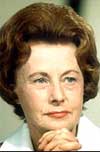 |
1968-70
First Secretary of State and Secretary of State for Employment and
Productivity Barbara
Castle, United Kingdom of Great Britain
and Northern Ireland |
|
Vice-Chairperson
1957-58 and Chairperson of Labour 1958-59, 1961 Leadership Candidate,1964-65 Minister of Overseas Development,
1965-68 Minister of Transport, 1968-70 she was the third-ranking in the Cabinet,1974-76 Secretary of State of Social Security and Health
Vice-President of the Socialist Group of the European Parliament 1985-89,
Created Baroness Castle of Blackburn 1989 and is still a very active
member of the House of Lords until her death. She lived (1910-2002) |
|

|
1971-2003 Temporary Counsellor of State HRH The Princess Royal,
Princess Anne of United Kingdom and Great Britain and Northern Ireland |
|
In
1999 she was appointed to the ceremonial position of Golden Stick in
Waiting. As the only daughter of Queen Elizabeth she has acted as
Counsellor of State
on many occasions when her mother was abroad. She was replaced by Prince
William of Wales upon his 21st birthday. Married twice and mother of two
children.
(b. 1950-). |
|
 |
1979-90 Prime Minister The Rt. Hon. Margaret Thatcher, United
Kingdom of Great Britain
and Northern Ireland |
|
Born Margaret Hilda Roberts, she was MP 1959-90, Parliamentary
Secretary of Pensions and National Insurance 1961-64, Secretary of
State of Education 1970-74, Shadow Minister of Environment and Housing
1974-75, Shadow Special Minister of Finance and Public Expenditure
1975, Leader of The Conservative Party 1975-90, Leader of Her
Majesty's Opposition 1975-79. As
Prime Minister
she
was also First Lord of the Treasury and Minister of the Civil
Service. In 1982 she ordered British troops to the Falkland Islands to
retake them from Argentina. She took a strong stand against the trade
unions during the miner's strike, and moved Britain toward
privatization, selling minor interests in public utilities to the
business interests. She also introduced "rate capping" which
effectively took control of expenditures out of the hands of city
councils, part of her policies aimed at reducing the influence of
local governments. In 1989, she introduced a community poll tax. In
1990, her cabinet was divided over issues including the European
Community, which forced her resignation. When her party leadership was
challenged in 1990, she resigned and was Created Baroness Thatcher
of Kestaven and became a member of the House of Lords two years
later. Mother of twins.
(b. 1925-). |
|

|
2006-07 Secretary of Foreign and
Commonwealth Affairs
Margaret Beckett, United Kingdom of Great Britain and Northern
Ireland |
|
Assistant Government Whip 1975-76 and 1976-79 Junior Minister of
Education, Deputy Leader of Labour 1992-94, Acting leader after the
death of John Smith, and she was a candidate for both the Leadership
and the Deputy Leadership of Labour, held various Posts in the Labour
Shadow Cabinets 1989-97, President of the Board of Trade and Secretary
of State for Trade and Industry 1997-98, President of the Council and
Leader of The House of Commons, Deputy Government Spokesperson and
Minister in charge of the Millennium Bug 1998-2001 and Secretary of
State for Environment, Food and Rural Affairs 2001-06. Minister
of Hosing from 2008. (b. 1943-). |
Last update
06.02.12
|